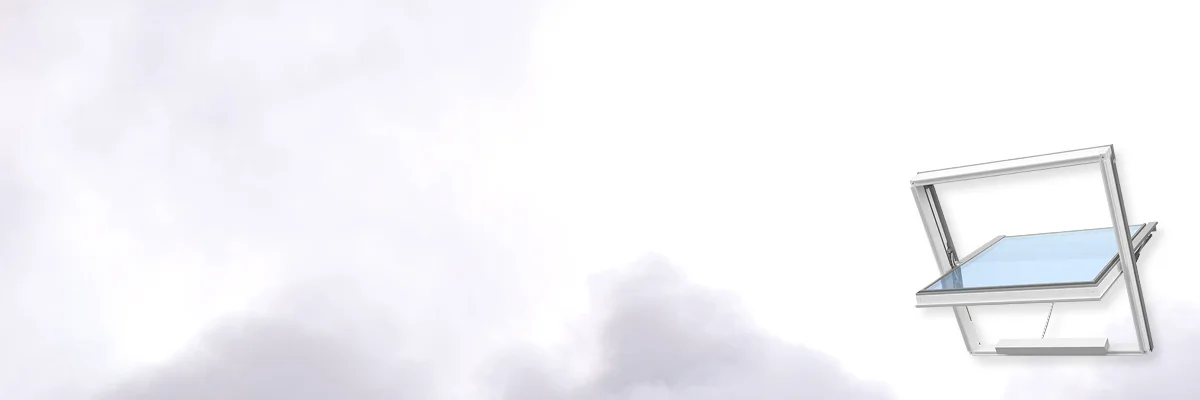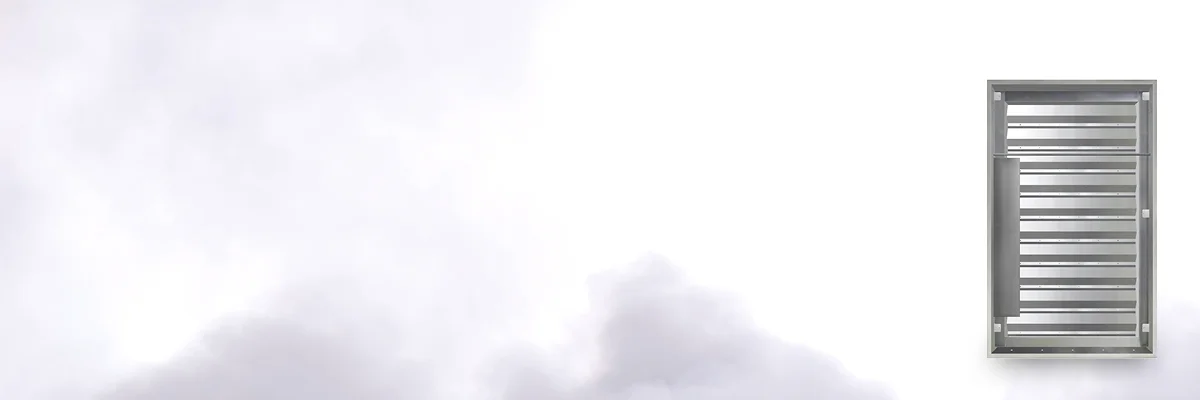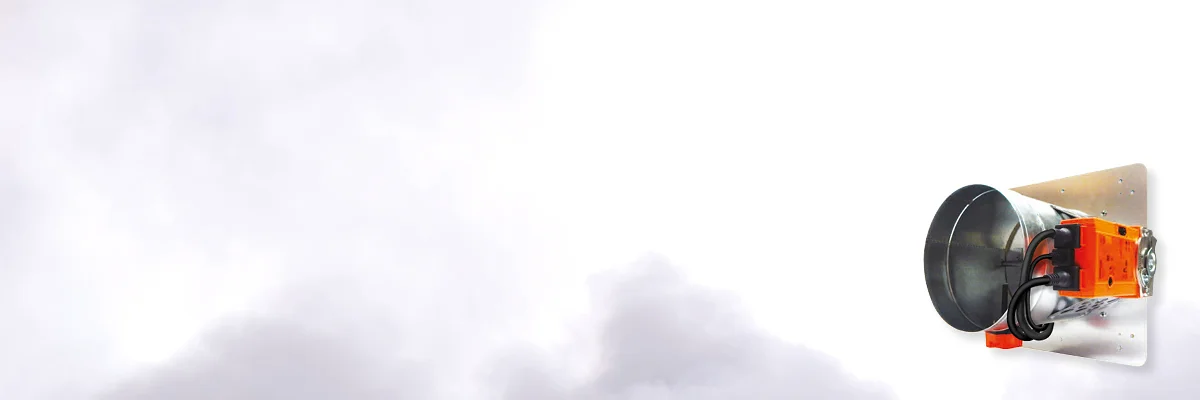
An actuator schedule arrives with one line per window: “24V actuator, 500mm stroke”. Nothing about drive type, nothing about sash weight, nothing about which way the window opens. Someone has to turn that into an order, and whoever does it is making a fire safety decision whether they realise it or not.
Chain, linear and rack drives are not interchangeable. They differ in force, in stroke, in how they behave through the opening arc, and in what happens to the certification of the vent assembly if you swap one for another. Here is how to choose between them, and what changes when the window is part of a certified smoke vent rather than an office rooflight.
The Three Drive Types and What Each One Does
A chain actuator turns a sprocket that pushes an articulated chain out of a compact housing. The links lock straight in one direction, so the chain can push the sash open and pull it closed but takes no side load at all. The housing is small enough to sit on the frame or the sash without dominating the reveal, which is why chain drives dominate UK window automation. Single-chain units in the ranges we stock run from around 100N on a WindowMaster WML 825 to 400N on a Topp C40 or Mingardi Micro EVO 2. Twin-chain units put two chains and two push points in one housing: the UCS Twin Quasar and Twin Vega both deliver 600N.
A linear actuator drives a rigid rod along a fixed axis, usually through a screw and nut. There is no articulation, so the drive is stiffer, the force per unit of body size is higher, and the rod holds the sash in position against wind pressure rather than relying on chain tension. It also sits proud of the frame, which architects sometimes object to and sometimes prefer to a visible chain. A Mingardi EURO 1 covers 450N to 1000N with an adjustable stroke from 70mm to 500mm. A Topp S80 delivers 800N across a 200mm to 1000mm stroke at 24V.
A rack actuator drives a toothed rack with a pinion. Because the pinion stays engaged with the rack for the whole travel, the force is the same at 50mm of stroke as it is at 950mm, and the mechanism is quieter than a chain. Rack drives are the answer to long strokes and high duty cycles. A UCS T-Rack gives 650N to 750N over a 350mm to 1000mm stroke; a Mingardi DRIVE EVO2 gives 1000N push and pull over 180mm to 1000mm. Where a wide sash needs two push points, UCS Rack Dual and Rack Double kits link a main and an auxiliary unit with 12mm connecting rods so both racks move together.
| Chain | Linear | Rack | |
|---|---|---|---|
| Mechanism | Articulated chain from a sprocket | Rigid rod on a screw drive | Toothed rack driven by a pinion |
| Force in stocked ranges | 100 to 400N single, 600N twin-chain | 350 to 1000N | 500 to 1000N |
| Stroke in stocked ranges | 50 to 1000mm | 70 to 1000mm | 180 to 1000mm |
| Force across the stroke | Limited by chain stability at full extension | Consistent | Consistent end to end |
| Noise | Audible chain movement | Motor and screw noise | Quietest of the three |
| Appearance | Most discreet | Visible rod when open | Visible rack when open |
| Natural fit | Top-hung and bottom-hung AOV windows | Heavy sashes, exposed rooflights, louvre linkages | Long stroke, high cycle counts, quiet spaces, twin-point opening |
Force and stroke figures are those of the products we hold. Other manufacturers go higher and lower, and the figures on a specific datasheet always beat a general range.
Force: Matching the Actuator to the Sash
Datasheets quote thrust in newtons with a kilogram equivalent alongside it: 250N to 300N and 25kg to 30kg on a UCS Vega, 650N to 750N and 65kg to 75kg on a UCS Rack. That kilogram figure is not the weight of window the actuator will open. It is the force the actuator can deliver at its push point, expressed in a unit installers find easier to picture.
What the actuator actually has to overcome is a combination of things, and only one of them is on the drawing:
- The share of sash weight resisting movement, which changes with the opening direction and through the arc
- Friction in hinges, stays and restrictors, which on a retrofit can be the dominant term
- Compression of the perimeter gaskets on the final part of the closing stroke
- Wind pressure on an exposed facade or roof position, in both directions
- Snow or standing water loading on a rooflight or dome
Opening and closing are separate load cases and the worst one governs. A top-hung outward-opening window has to be lifted against gravity for most of its travel, so opening is usually the hard case. A bottom-hung inward-opening hopper is helped open by gravity and fights the actuator on the way closed, and an AOV window that does not close fully is a defect at the next inspection. Get the closing case wrong and the system will pass its first test and fail its winter one.
The practical answer is the manufacturer’s selection chart, which cross-references sash weight against sash width and opening angle for that specific model. Read the answer off the chart and then leave headroom. Selecting at the rated limit gives you nothing for the friction that arrives with age, and an actuator working at its limit is the one that stalls at 4am on a cold morning.
Stroke, Opening Angle and Free Area
Stroke is linear travel. Opening angle is what the fire strategy cares about, and the two are related by geometry, not by a constant. A 500mm stroke on a 1000mm tall top-hung sash produces a much wider angle than the same 500mm on a 2000mm sash, and moving the actuator’s push point closer to or further from the hinge changes it again.
This is where free area gets lost. For a natural smoke vent, the number that counts is the certified aerodynamic free area of the whole assembly at the opening position it was tested at, not a geometric area you can derive from the stroke. The vent is tested to BS EN 12101-2 in one configuration, and the certified aerodynamic free area belongs to that configuration. If the installed actuator does not drive the sash to the tested opening position, the certificate does not describe what is on the wall. We have set out the geometric and aerodynamic distinction in What Is Free Area and Why Does It Matter for Smoke Ventilation?, and there is a free area calculator for working through the arithmetic.
Adjustable-stroke actuators make this easier and riskier at the same time. A Topp C40 has seven stroke positions between 100mm and 500mm; a Mingardi Micro EVO 2 has four between 150mm and 600mm; a WindowMaster WMX 826 adjusts anywhere from 50mm to 500mm. Convenient on site, and completely invisible once the actuator is fitted. The set position needs to be recorded on the commissioning documentation and verified by measurement, not assumed from the model number. A stroke limiter left at the factory setting is one of the more common reasons a stairwell vent measures short of its 1.0 m² design free area on handover.
Window Type Decides More Than the Datasheet Does
Top-hung outward-opening. The standard AOV window and the natural home of the chain actuator, mounted on the frame at the cill with the chain pushing the sash outward. Heavier or wider sashes move you up the force range and then across to a linear or rack drive.
Bottom-hung inward-opening. Chain drives work here too, mounted at the head, but the load case flips: gravity opens the sash and the actuator has to pull it closed against the seals. Restrictor arms are needed to control the sash, and their friction has to go into the force calculation.
Side-hung. The least forgiving of the four. A drive fixed to the frame has to push close to the hinge line to fit within the reveal, which means a lot of stroke for a small angle, and it applies a twisting load to a sash whose hinges are already carrying its full weight. Check that the manufacturer offers a mounting arrangement for a side-hung application before assuming a standard chain unit will do the job, and expect a bracket set rather than a straight fix.
Pivot windows. Centre-pivot and horizontal-pivot AOV windows balance the sash about the pivot axis, so the gravity component is smaller, but the geometry is fussier: the distance between the pivot and the push point changes as the sash rotates. Use the vent manufacturer’s own bracket set. This is one of the places where buying the actuator separately from the window causes trouble.
Rooflights, domes and louvres. Long stroke, exposure, snow load and often a linkage between the drive and the blades. Linear and rack drives handle all four better than a chain does, and a rack actuator’s constant force across a 1000mm stroke is genuinely useful on a large dome. Where the opening is wide, two synchronised drives beat one powerful one.
Voltage, Power and Synchronised Pairs
For smoke ventilation the voltage question is usually settled before you start. The system has to keep working after a mains failure, which means standby batteries in a smoke control panel complying with BS EN 12101-10. Those batteries supply 24V DC, and a 230V AC actuator cannot run from them without additional equipment nobody wants in a life safety system. 24V DC is therefore the default for anything on an AOV, and it is also what gives you battery-backed operation for the standby period the panel is specified to hold.
230V AC actuators have a place, and it is comfort ventilation. A rooflight on a thermostatic controller, an atrium vent for summer cooling, a plant room louvre: direct mains connection, no power supply unit, less cabling. Vent Trade stocks 24V and 230V thermostatic controllers for exactly this kind of standalone application. Part F territory, not Part B.
One 24V detail that catches people out: volt drop. A long run to a top-floor stairwell vent on undersized cable will deliver a healthy voltage at rest and sag under the inrush current when the actuator starts, and a marginal actuator becomes an unreliable one. Size the cable from the manufacturer’s table and count both legs of the run.
Synchronised pairs. Wide sashes need two push points, and two actuators are only a pair if they move together. Wire two ordinary units in parallel and small differences in load and motor speed will rack the sash, bind the hinges and leave one actuator carrying most of the work. Speed synchronisation is a specific feature: the UCS Quasar, Vega Synchro and Synchro T-Rack all carry it, the Mingardi Micro EVO 2 has it built in, and the WindowMaster WMX 826 and WMU 836 are designed to be run in synchronised groups. The UCS Rack Dual and Rack Double kits go further and mechanically link the main and auxiliary units with connecting rods so the two racks physically cannot get out of step.
Tandem drives. A twin-chain actuator is a different solution to the same problem: one housing, two chains, two push points, double the thrust. The UCS Twin Vega and Twin Quasar both give 600N this way, and there is only one unit to mount, wire and later maintain.
Where the panel or a BMS needs to know the window’s position, look for a feedback variant. Several UCS actuators offer an F-Signal option giving open and closed position feedback rather than assuming the window followed the command.
What BS EN 12101-2 Certification Means for Actuator Choice
This is the part that gets treated as paperwork and is not.
BS EN 12101-2 certifies a natural smoke and heat exhaust ventilator as a complete assembly. The frame, the sash, the hardware, the mounting and the actuator are tested together, and the classification set that comes out covers reliability cycles (Re), snow load (SL), wind load (WL), low ambient temperature (T) and resistance to heat (the B classification, where B300 30 means the ventilator still operated at 300°C for 30 minutes). The certified aerodynamic free area belongs to that same tested assembly. None of those classes belong to the motor on its own.
The consequence is direct: you cannot take a certified AOV window, fit a different actuator with the same stroke and the same force, and carry the certificate across. The tested combination has changed. Some actuators do hold EN 12101-2 certification on particular variants, the 24V DC Mingardi DRIVE EVO2 among them, but even then the certification describes the actuator’s performance as part of a tested vent assembly rather than as a standalone approval you can apply anywhere.
Nobody enjoys this on a maintenance call. An actuator has failed on a nine-year-old stairwell AOV, the original model is obsolete, and there is a visually identical unit with matching specifications on the shelf. Fitting it restores the window and quietly breaks the evidence chain for the vent. The defensible routes are a like-for-like replacement, a written equivalence statement from the vent manufacturer, or a retest, and whichever route you take belongs in the building’s fire safety information alongside the original certificate. Under the Building Safety Act 2022 that record is part of the golden thread, and we have covered what that means in practice in The Golden Thread and Smoke Ventilation.
For comfort ventilation none of this applies. A rooflight actuator with no smoke function can be replaced with anything that fits and performs. Knowing which of the two you are standing under is the whole job.
Noise, Speed, Weather and Retrofit
Noise. Chain drives make an audible mechanical sound as the chain articulates out of the housing. In a stairwell during a monthly test, nobody cares. In a school hall, a hotel bedroom, a library atrium or an open-plan office where the vents run daily for comfort cooling, people care a great deal, and rack drives are the quietest of the three by a clear margin. Duty cycle points the same way: a comfort vent might cycle several times a day for twenty years, which is a very different life from an AOV that opens under test once a month.
Speed. BS EN 12101-2 sets a time within which the ventilator must reach its open position under fire conditions, and it is the assembly that has to achieve it, with the actuator working under full sash load and at whatever voltage the battery is delivering at the end of its standby period. Test-condition speed on a bench is not the number that matters.
Ingress protection. Frame-mounted actuators in a weathered reveal are typically IP55, as on the Topp C40 and Mingardi EURO 1, and that is appropriate for dust and splashing. An actuator on a roof dome sees driven rain, standing water and ultraviolet exposure, and wants IP65, as on the UCS Ulysses. Choose the rating for the position, not the room, and pay attention to the low ambient temperature class on cold roof installations.
Retrofit. A measured survey beats the drawing every time. On an existing building the sash weight is often unknown, the hinges have twenty years of paint and grit in them, and someone has added a restrictor stay since handover. The reveal depth decides whether a chain unit fits at all. The available cable route often decides the voltage. And if the window is part of a certified smoke vent, everything in the previous section applies before you order anything. On a straightforward comfort retrofit, a manual retractive switch such as the Ventec R Switch gives occupants direct open and close control without a controller, which is frequently all a single rooflight needs.
Common Selection Mistakes
- Specifying force without geometry. “40kg actuator” tells you nothing until you know the sash width, the opening direction and the required angle.
- Treating stroke as free area. The certified aerodynamic free area belongs to the tested assembly at its tested opening position. Stroke is an input to that, not a substitute for it.
- Substituting an actuator on a certified vent. Same stroke and same force does not mean same certification. See above.
- Two actuators, no synchronisation. Parallel wiring is not synchronisation. Use a sync-capable model, a twin-chain unit, or a mechanically linked rack pair.
- 230V on a life safety vent. If the system has to operate after a mains failure, the actuator has to be able to run from the panel’s batteries.
- Designing for the opening stroke only. Closing against seal compression, and closing an inward-opening sash against gravity, are separate calculations.
- IP rating chosen for the room rather than the position. An IP20 unit inside a dome kerb is still outdoors as far as water is concerned.
- Adjustable stroke left at the factory setting. Set it, measure the result, and write it on the commissioning record.
Practical Takeaway
Start from the window, not the catalogue. Establish the opening direction, sash size and weight, the opening angle the free area calculation depends on, and whether the vent has a smoke function. That tells you the force and stroke you need and usually narrows the drive type to one. Chain for most top-hung and bottom-hung AOV windows, linear where the sash is heavy or the position exposed, rack where the stroke is long, the space is occupied or the opening needs two synchronised push points.
Then check three things before the order goes in. Is the voltage compatible with the standby power arrangement. Is the actuator part of a certified assembly, and if so is this the actuator that assembly was tested with. And has the stroke setting been specified as a number that will appear on the commissioning record. Those three questions catch the majority of actuator problems we get called about, and all three are cheaper to answer at specification stage than at handover.
Further Reading
- What Is Free Area and Why Does It Matter for Smoke Ventilation?
- Choosing an AOV for a Stairwell: Roof Vent vs Window
- Anatomy of a Smoke Control System: Every Component Explained
- The Golden Thread and Smoke Ventilation
- Free area calculator
Sources
Official guidance and standards referenced in this article:
- BS EN 12101-2:2017, BSI Knowledge
- Approved Document B (fire safety), GOV.UK
- Building Safety Act 2022, GOV.UK
- Smoke Control Association
- WindowMaster: Guide to EN 12101-2 and factory production control requirements
Need Help Sizing an Actuator?
We stock chain, linear and rack window actuators from UCS, Topp, Mingardi and WindowMaster, with UK stock in Poole and next-working-day despatch on most lines. Send us the sash dimensions, weight, opening direction and required angle and our technical team will size it against the manufacturer’s selection charts before you commit.
Call 01202 725 689 or email info@vent-trade.co.uk.