Fire dampers and smoke dampers are both installed in ductwork, both are activated during fire conditions, and both have the word “damper” in their name. The similarity ends there. They are fundamentally different products designed for different purposes, governed by different standards, and failing them is a different kind of problem.
Confusing the two is one of the most common specification mistakes in building services. A fire damper installed where a smoke damper is required will not perform the smoke control function. A smoke damper installed where a fire damper is required will not provide fire compartmentation. In either case, the building’s fire safety strategy has a gap.
This article explains what each type of damper does, when each is required, and what standards apply.
What Is a Fire Damper?
A fire damper is a passive fire protection device. Its purpose is to prevent fire from spreading through ductwork that penetrates a fire-rated compartment wall or floor.
When ductwork passes through a fire-rated compartment boundary - for example, a fire wall between two areas of a building - the duct represents a potential path for fire to bypass the compartmentation. A fire damper closes to seal the duct opening when heat is detected, preventing the spread of both fire and hot combustion gases through the ductwork.
How Fire Dampers Activate
Fire dampers are normally held open by a fusible link - a mechanical component designed to melt at a specific temperature. When the air temperature in the duct reaches the trigger temperature (typically around 72°C, though higher ratings exist), the fusible link melts and the damper blade closes under spring tension.
Fusible link operation is entirely passive - it requires no electrical power, no control signal, and no active system to operate. The damper closes automatically in response to heat.
Some fire dampers also have electrical actuation (electrically operated fire dampers or electrothermal release dampers), allowing remote testing and closure. These are increasingly common in accessible ductwork where the fire damper needs to be testable without physical access to the fusible link.
Fire Damper Standards and Certification
Fire dampers are CE/UKCA-marked under product standard BS EN 15650, tested per BS EN 1366-2 (fire resistance tests for service installations including ductwork and dampers), and classified per BS EN 13501-3. The key performance parameter is fire resistance, expressed as a combination of integrity (E) and insulation (I) ratings. A fire damper rated EI 90 provides 90 minutes of fire resistance.
Fire dampers must be CE or UKCA marked, with a declaration of performance confirming their fire resistance rating in the intended installation configuration. The installation configuration matters - a fire damper tested and certified in a vertical duct may not have certification for horizontal installation, and vice versa.
When Fire Dampers Are Required
Fire dampers are required wherever ductwork penetrates a fire compartment boundary that is required to maintain its integrity during a fire. The requirement is typically identified in the fire strategy and specified in the mechanical services design.
Common locations include:
- Ductwork passing through fire walls between different tenancies or uses
- Ductwork penetrating fire floors in multi-storey buildings
- Extract and supply ductwork in escape corridors where it passes through compartment boundaries
- Kitchen extract ductwork passing through multiple floors
The determination of which compartment boundaries require fire dampers is a fire engineering decision based on the building’s compartmentation strategy.
What Is a Smoke Damper?
A smoke damper is an active component of a smoke control system. Its purpose is not to prevent fire spread but to control smoke movement - directing smoke out of the building through designated exhaust paths while closing off escape routes and adjacent areas from smoke contamination.
Unlike a fire damper, a smoke damper does not close automatically in response to heat. It is controlled by the smoke control panel as part of an engineered smoke ventilation strategy.
How Smoke Dampers Operate
Smoke dampers are electrically actuated. In a smoke ventilation system for a multi-storey residential building, for example:
- On a fire alarm activation on floor 5, the smoke control panel sends signals to all smoke dampers in the building
- The damper on floor 5 opens (or remains open) to allow smoke extraction from that floor’s lobby
- Dampers on all other floors close, isolating those floors from the smoke shaft (zone lockout)
- The extract fan runs, drawing smoke from floor 5 out through the shaft
The smoke damper’s position is determined by the smoke control panel’s cause and effect matrix, not by the physical conditions in the duct. A smoke damper on floor 10 might close even if there is no smoke anywhere near it, simply because the fire is on floor 5 and floor 10 must be isolated.
Smoke dampers must have fail-safe actuation - they fail to a defined safe position (typically closed) on loss of power or control signal. This is the opposite of some HVAC dampers, which may fail open. In a life safety system, the fail-safe position must be the position that protects occupants, not the position that maintains system balance.
Smoke Damper Standards and Certification
Smoke dampers used in smoke control systems are covered by BS EN 12101-8, which specifies performance requirements for smoke control door and shutter assemblies and smoke dampers. The key performance parameters include:
- Smoke leakage class - the damper’s resistance to smoke leakage when closed, measured at ambient temperature and elevated temperature
- Opening and closing time - how quickly the damper responds to a control signal
- Endurance - the number of operation cycles the damper must withstand
- Temperature resistance - for high-temperature smoke conditions
Smoke control dampers are certified to BS EN 12101-8 as the product standard, tested per BS EN 1366-10, and classified per BS EN 13501-4. This is distinct from the BS EN 15650 / BS EN 1366-2 / BS EN 13501-3 framework for fire dampers. A product can be certified to one, the other, or both. A combined fire and smoke damper is certified to both standards and can serve both functions.
When Smoke Dampers Are Required
Smoke dampers are required wherever the smoke ventilation strategy requires active control of smoke movement through ductwork or a smoke shaft. This is determined by the smoke ventilation design, which in turn is determined by the fire strategy.
Common applications include:
- Smoke shaft extract systems in multi-storey residential buildings (a damper on each floor)
- Mechanical corridor ventilation systems where floor-by-floor isolation is required
- Basement smoke extract systems
- Any mechanical smoke ventilation system where zone control is required
See our range of smoke and natural dampers for certified smoke damper products suitable for these applications.
Combined Fire and Smoke Dampers
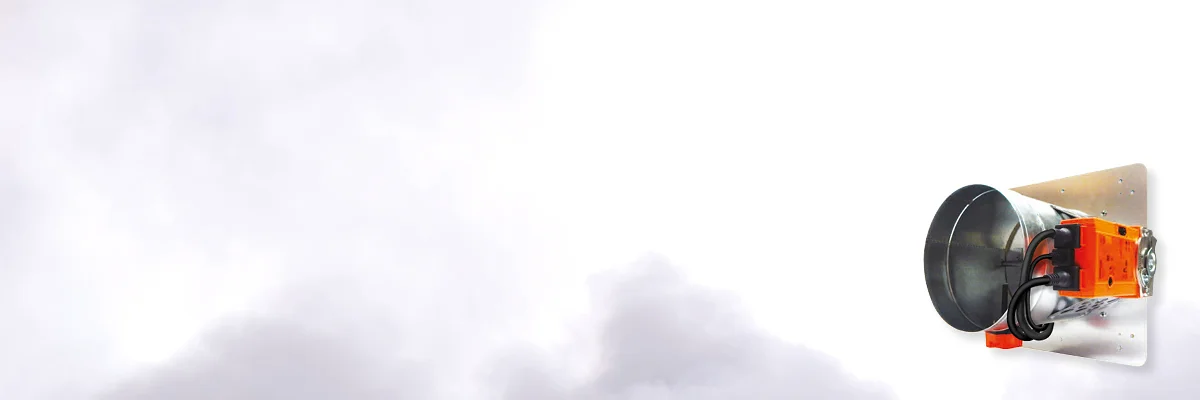
In many installations, ductwork must both penetrate a compartment boundary (requiring fire resistance) and be part of a smoke control system (requiring smoke damper functionality). In these cases, a combined fire and smoke damper - sometimes called a multifunctional damper - is used.
Combined dampers are certified to both BS EN 15650 (fire damper product standard, tested per BS EN 1366-2) and BS EN 12101-8 (smoke control damper product standard, tested per BS EN 1366-10). They incorporate both the fusible link or thermally operated fire closure mechanism and the electrical actuation for smoke control operation.
Specifying a combined fire and smoke damper where one is needed - rather than trying to install separate dampers - is generally simpler and more reliable. It also eliminates the potential for an installation that has a fire damper but not a smoke damper, or vice versa.
Common Specification Mistakes
Installing fire dampers where smoke dampers are required
Fire dampers do not respond to electrical control signals. A fire damper installed in a smoke shaft will not open or close on command from the smoke control panel. It will sit in a fixed position (normally open) regardless of which floor has a fire alarm activation. Zone lockout is impossible. The smoke control strategy is non-functional.
Specifying smoke leakage class incorrectly
Smoke dampers are classified by their smoke leakage at both ambient temperature (300 Pa) and elevated temperature (500 Pa, or 1000 Pa per BS 9991:2024). A damper specified for ambient temperature only may be inadequate where the smoke is expected to be hot. The smoke leakage class should be specified based on the expected smoke temperature in the particular application.
Not specifying fail-safe position
The fail-safe position of a smoke damper must be specified based on the smoke control strategy, not left as a default. In most smoke shaft applications, fail-safe closed is required. But in a pressurisation system supply damper, fail-safe open may be appropriate. Leaving the fail-safe position unspecified and accepting whatever the manufacturer’s default is may result in a system that fails dangerously.
Mixing certified and uncertified products
Smoke dampers in life safety systems must be certified to BS EN 12101-8. Specifying uncertified dampers - or substituting HVAC volume control dampers - is not acceptable in smoke control applications, regardless of the supplier’s assurances. Always check the certification and request the test certificate.
Practical Takeaway
Fire dampers and smoke dampers are different products. Check the fire strategy to determine which type is required in each location - many buildings need both, in different parts of the ductwork. Specify products to the correct standard (BS EN 15650 for fire dampers, BS EN 12101-8 for smoke dampers) and always ask for the Declaration of Performance and test certificate. Where both fire resistance and smoke control are needed in the same location, specify a combined fire and smoke damper certified to both standards.
For technical queries on damper selection and specification, contact the Vent Trade technical team on 01202 725 689 or email info@vent-trade.co.uk. See our smoke and natural dampers range for certified products.