On the night of 14 June 2017, a fire in the Grenfell Tower refurbishment in west London killed 72 people and changed the UK fire safety regulatory environment more than any other single event in living memory.
This article is about what that fire, and the investigations that followed, changed in the specification of smoke ventilation systems in the UK. It is written factually, not sensationally. The objective is to help building managers, fire alarm contractors, specifiers and installers understand the current regulations and why they look the way they do.
The Immediate Aftermath
In the weeks and months after the fire, the initial focus was on the external cladding, specifically, the aluminium composite material (ACM) panels with combustible polyethylene cores that had contributed to the unprecedented spread of the fire up the facade.
But as the investigations progressed, it became clear that the cladding was a symptom of a wider systemic failure. The Dame Judith Hackitt Review, “Building a Safer Future” (2018), concluded that the regulatory system governing high-rise residential buildings was “not fit for purpose” and required “fundamental reform.”
The Review’s findings extended well beyond cladding. It identified weaknesses in procurement, design, construction, handover, maintenance, and the documentation of fire safety throughout a building’s lifecycle. These findings are the basis for most of the regulatory changes that have followed.
Approved Document B Revisions
Approved Document B, the government’s approved guidance on fire safety compliance with the Building Regulations, has been revised multiple times since 2017.
Key changes relevant to smoke ventilation include:
Tighter requirements for residential buildings at least 11 metres in height. The requirement for automatic opening vents in common escape routes has been clarified, and the consequences of non-compliance have been made more explicit.
Restrictions on combustible materials. The 2018 ban on combustible materials in the external walls of high-rise residential buildings at least 18 metres in height influenced the specification of AOV products fitted to those walls, particularly louvre vents and facade-mounted AOV windows.
Clearer linkage to BS 9991 and BS 9999. Approved Document B now more explicitly cross-references the British Standards for residential and non-residential fire safety, which in turn reference BS EN 12101 for smoke control system components.
Emphasis on commissioning and handover. The importance of proper commissioning, documented test results, and a complete handover pack is reinforced. This is a direct response to findings that many buildings had smoke ventilation systems that had never been properly commissioned or tested after installation.
BS 9991:2024
BS 9991, the British Standard for fire safety in residential buildings, was significantly revised in 2024. The changes affect smoke ventilation specification in several ways:
- Stricter requirements for the documentation of the fire strategy
- Clearer guidance on the specification of smoke control systems in taller residential buildings
- More explicit linkage between the fire strategy, the physical installation, and the ongoing management of the building
- Alignment with the Building Safety Act’s Golden Thread requirements
BS 9991:2024 is not retrospectively applicable to all existing buildings, but it sets the expected standard for new works, major refurbishments, and any situation where the fire strategy is being reviewed.
The Fire Safety Act 2021 and Fire Safety (England) Regulations 2022
The Fire Safety Act 2021 clarified that the external walls of multi-occupancy residential buildings, and all doors between domestic premises and common parts, fall within the scope of the Regulatory Reform (Fire Safety) Order 2005.
This had a practical effect on smoke ventilation: the Responsible Person’s duties to maintain fire safety equipment explicitly include the AOV system, the smoke control panel, and all associated components. Failure to maintain these systems in effective working order is a criminal offence by a named individual, not an abstract organisational failure.
The Fire Safety (England) Regulations 2022, which came into force in January 2023, added specific duties for residential buildings of at least 11 metres in height, including the requirement for quarterly checks of fire doors in common areas, and annual checks of fire doors to individual flats. These regulations also require building managers to make evacuation plans and information about fire safety measures available to the fire service.
For smoke ventilation, this means the system must not only be maintained. The maintenance must be documented, the documentation must be accessible, and the fire service must be able to find what they need when they arrive.
The Building Safety Act 2022
The Building Safety Act 2022 is the most significant piece of UK fire safety legislation since the Grenfell fire. For smoke ventilation specifically, the most important elements are:
The Building Safety Regulator
A new statutory regulator, sitting within the Health and Safety Executive, with responsibility for the safety of higher-risk residential buildings. The BSR can inspect buildings, require information from Accountable Persons, and take enforcement action where duties are not being met.
For smoke ventilation, this means the documentation of the system, design, installation, commissioning, modification, maintenance, must be available to the BSR on request. Not “we will dig it out of the filing cabinet.” Ready, digital, current.
The Accountable Person
A new statutory role for residential buildings of at least 18 metres in height or at least 7 storeys, containing at least 2 residential units (Building Safety Act 2022 s.65). The Accountable Person has specific duties to assess and manage building safety risks, including those relating to smoke ventilation.
The Accountable Person is typically the freeholder or the organisation responsible for managing the building. The role carries personal criminal liability for serious failures.
The Golden Thread
The single biggest change in how smoke ventilation systems must be documented. The Golden Thread is a digital, continuously updated record of all building safety information throughout the building’s lifecycle. For smoke ventilation, this includes:
- Every component’s certification (Declaration of Performance to the relevant part of BS EN 12101, e.g. Part 2 for natural vents, Part 3 for powered exhaust, Part 8 for smoke dampers, Part 10 for power supplies)
- The original cause and effect schedule
- Every configuration change, with user identity and timestamp
- Every maintenance visit and test result
- Every modification to the system
Paper logbooks and filing cabinets cannot meet this requirement. Neither can dip-switch smoke control panels that have no audit trail.
Mandatory building safety cases
For higher-risk buildings, the Accountable Person must produce and maintain a building safety case, a documented safety argument demonstrating that the building’s fire and structural safety risks are being managed effectively. The smoke ventilation system is a key input to this case.
How the Industry Is Responding
The regulatory changes have triggered a corresponding response from the smoke ventilation industry.
Certification scrutiny. Third-party certification to BS EN 12101 is now a minimum expectation, not a nice-to-have. Fire risk assessors and specifiers are actively checking Declaration of Performance certificates, and products without current certification are being removed from specifications.
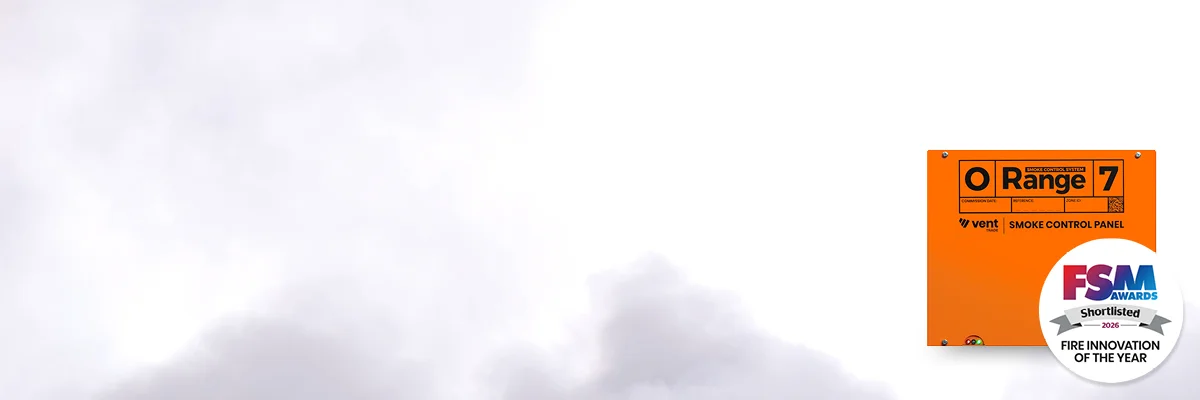
Secure configuration. Smoke control panels with dip-switch configuration are being replaced by panels with authenticated software configuration and tamper-evident audit trails. The O Range 7, launched by Vent Trade in 2025, is one response to this shift, explicitly designed for Golden Thread compliance.
Documentation culture. Commissioning certificates, asset registers, and maintenance records are becoming central to smoke ventilation projects, not afterthoughts. Building managers are asking for the records at handover, and fire risk assessors are checking for them on review.
Competency. IFC SDI 19, the UKAS-accredited installer scheme administered by IFC Certification Ltd, has moved from “preferred” to “required” on most public sector and higher-risk residential projects. It is a mandatory requirement for Smoke Control Association installer members.
Industry coordination. The Smoke Control Association has taken a more active role in setting standards, publishing guidance, and feeding expertise into the regulatory process. As an SCA member, we have seen the level of engagement from fire engineers, installers, and manufacturers increase significantly since 2017.
What Has Not Changed Enough
It would be dishonest to pretend that the regulatory environment now fully addresses the risks that Grenfell exposed. There are areas where change has been slower, or incomplete, or where the intent has not yet been matched by implementation.
Legacy installations. Many UK buildings still have smoke ventilation systems designed and installed under earlier regulations, with dip-switch panels, paper logbooks, and inconsistent maintenance regimes. Bringing these up to current standards is a multi-year undertaking and, for buildings outside the Building Safety Act’s direct scope, is not legally required in most cases.
Competency enforcement. The Building Safety Act requires competent persons to carry out work on higher-risk buildings, but the practical enforcement of competency requirements is still developing. There are installers doing smoke ventilation work today who would not meet the standards a competent regulator should expect.
Supply chain traceability. The Golden Thread requires documented certification for every component. This is straightforward for new installations but difficult for components installed decades ago, where certification documents may have been lost. Resolving this gap is ongoing.
Post-handover management. The Accountable Person has statutory duties, but the practical arrangements for discharging those duties vary widely between buildings. Training, resource allocation, and industry expectations are still being established.
What This Means for You
If you are specifying, installing or managing smoke ventilation in UK buildings today, the practical implications are:
For building managers: Understand your duties under the Fire Safety Order and, if your building is in scope, the Building Safety Act. Make sure the smoke ventilation system has a current asset register, a maintenance programme, and a named competent person. Ask about the Golden Thread.
For fire alarm contractors: The interface between the fire alarm and the smoke control panel is one of the highest-scrutiny interfaces in the building. Test it, document the test, and make the documentation available to the Responsible Person.
For specifiers: Specify to BS EN 12101. Check Declaration of Performance certificates. Consider Golden Thread compliance from the design stage, not retrofitted afterwards.
For installers: Competency matters. Documentation matters. Commissioning matters. The days of “it switched during commissioning so it is fine” are over.
Why We Built the O Range
As a family business that has been supplying smoke ventilation to the UK trade since 1988, we have watched this regulatory shift happen up close. The Grenfell fire reset how the whole industry thinks about fire safety documentation and accountability, well beyond the high-rise residential sector where it began.
The O Range 7 was designed specifically for the post-Grenfell regulatory environment. No dip switches. Authenticated configuration. Tamper-evident audit trail. Golden Thread ready out of the box.
That last point matters most. The Golden Thread requires a building’s safety information to stay accurate and attributable across its whole life, so anyone can see who changed what and when. The O Range 7 locks configuration behind engineer two-factor authentication and records every change in a digital audit trail, so each one is attributable to the engineer who made it and stays traceable from commissioning onward. A dip-switch panel cannot tell you who set it, or when.
The same thinking carries into the hardware. A firefighters’ switch is for the fire service during a smoke event, not for everyday use by anyone else. The O Range keeps the high-visibility orange override inactive in normal conditions and only brings it live when a smoke event is detected, so it does what its name says and nothing more. That rules out vandalism and unauthorised use, while leaving the switch fully available to firefighters the moment it is needed. Where a project wants the switches live at all times, that can be configured.
Here is the part that matters most. “Smart, secure, verified” is easy to print on a panel. The O Range 7 is the first one where you can prove all three. That is why we built it. Smoke control you can prove.
Further Reading
- The Golden Thread and Smoke Ventilation: What the Building Safety Act Means for You
- BS 9991:2015 to BS 9991:2024 - What Changed and What It Means for Your Building
- Changes to Approved Document B: What You Need to Know
- Why Dip Switches Are Killing Your Golden Thread Compliance
Sources
Official guidance and standards referenced in this article: